Katie Gutierrez

My biggest fear around becoming a mother was that suddenly I would no longer be a writer.


(December 17, 2020) Katie Gutierrez lives in San Antonio, TX, with her husband and two young children, who are 2 and a half years old and three and a half months old. She has an MFA from Texas State University, and her writing has appeared in The Washington Post, Longreads, Catapult, and more. Her debut novel, More Than You’ll Ever Know, will be published by William Morrow in 2022. She describes writer-motherhood in three words as never enough time.

FROM THE EPISODE: READING LIST & REFERENCES

Katie Gutierrez’s Website

Katie’s Book: More Than You’ll Ever Know

Catch Me If You Can

Texas Highways Magazine (coming soon)

Alice Monro


SOUND BITES

When I got my book contract, any time I tried to sit down at my computer, my toddler would come in as a baby shark, or my newborn would be hungry. I ended up sitting in the dark breastfeeding, looking through the contract on my phone and signing it through DocuSign. You have this fantasy, as a writer, of what these moments will look like, and I never once envisioned it looking like that. But it also felt completely right for where I am in my life right now.

“A component of female desire is the desire to be known, to be seen, and to discover who we are in different environments and relationships.” — @katie_gutz

The experiment for me is to look at a character who is acting in an ostensibly amoral way and portray her in a way that very quickly makes her actions understandable. That’s part of the fun of writing for me. And that is when you’re succeeding as a writer.

When I found out I was pregnant, I was overjoyed. But right along with that feeling of joy was this fear, this feeling of Oh, God, what did I do? What is this going to mean for my life? That all came up, and it was not as simple of an emotion as getting that phone call from the nurse. Because I still didn’t really have an idea of how motherhood would fit into my life, and I didn’t really have an idea of what kind of mother I would be.

“When I found out I was pregnant, I was overjoyed. But right along with that feeling of joy was this fear, this feeling of: Oh God, what did I do? What is this going to mean for my life?” — @katie_gutz

When we were on submission with my first novel and it didn’t work out, I had this overwhelming sense of, Okay, I’ve got one more shot. I’ve got to finish this book before I have the baby, and we’ve got to go on submission and try to make this happen, because I don’t know what it’s going to be like afterwards. And I think that I was really wrong about that. I had internalized that being a mother is anathema to being a creative individual, to pursuing any kind of art.

“My biggest fear around becoming a mother was that suddenly I would no longer be a writer.” — @katie_gutz

It’s been a big surprise, how much being a mother has positively impacted what I do, even though actually getting to work, getting to write, is more complicated.

I spent those first few months not sleeping, because all I could do was imagine every single worst-case scenario that could happen to this completely helpless baby. Being a writer, your imagination is pretty vivid, and I felt like I had to follow each fantasy through to its conclusion. I was surprised at the depth of that anxiety, the depth of my fear around losing my child and how that fear never goes away; it just becomes folded into your daily life as a mother.

“When we become mothers, we don’t stop being ourselves or having our own desires or experiencing the desire for adventure. It becomes a question of how to balance these deep emotions–or live with the imbalance.” — @katie_gutz

The days when I’ve become the most frustrated, the angriest, and the worst version of myself—you know, the monster, to my kids and husband—are the days when I wake up with an urgent need and expectation that I’m going to sit down for at least an hour, and revise one chapter or write 500 words. When I set these concrete goals for myself, and then the day explodes and none of it happens, that’s when I find myself extremely resentful of my kids, my husband, the fact that he doesn’t have to have a baby at his boob every two hours.

I try to let go of control and tell myself I’m just going to touch the work at some point today. That’s my only goal. I’m going to touch it at some point, if it’s working on one sentence, so be it. If I get lucky and both kids nap at the same time, I get two hours. Those are the days when things go the smoothest for me, when I can appreciate being with the kids but also whatever time that I actually get to work. Those are the days when I don’t set any expectation for myself, except that I’m going to touch the work and move it forward in some way.

I was thinking about practical strategies for moms with newborns, and for me, what works best is when I read books that seem to be in conversation with what I’m working on. That feels like I’m touching the work. It’s also giving myself permission to daydream and to use those daydreams as also touching the work.

I’m taking this time with a newborn to be active about using my daydreams for the revision process. When I get the chance to sit down, even if it is for 15 minutes, I go straight to it, no procrastination.

In the past, there’s been this conversation around writing as a very solitary, strictly scheduled or regimented existence. There’s so much happening in the background in this patriarchal society and sexist culture that was not talked about. It’s important to have these conversations about what it really takes to make a book happen.

The other day, I held up a book to my daughter and said, “Mommy’s writing these books.” And I could see her trying to put it together. It was a strangely emotional moment for me, having this small child who was starting to understand what I’m doing when I’m not being present with her.

When my daughter is old enough to read my books, I hope she’ll feel proud, whether or not she likes the books. I think that’ll be strange, because she’ll be getting access to some parts of me that she obviously doesn’t see as her mother. I hope it’ll bring us closer.

I just texted a friend the other day—it was one of the bad days—and I said, “I feel like I’m failing on every front.” I was snapping at my daughter and I was so resentful of this baby boy who just wouldn’t sleep. Every time I sat down, I had to get back up. I felt like everything I was trying to do, everything I was trying to be, was a complete failure. Some days are just going to be like that.

You don’t have to be sitting at your computer to be writing, but it’s also okay to just not be writing. It’s okay to do absolutely nothing that touches your work, because you’re also a person apart from being a mother, and apart from being a writer, and you need to be able to occasionally take care of that person, as well. Let’s become the monster, right?

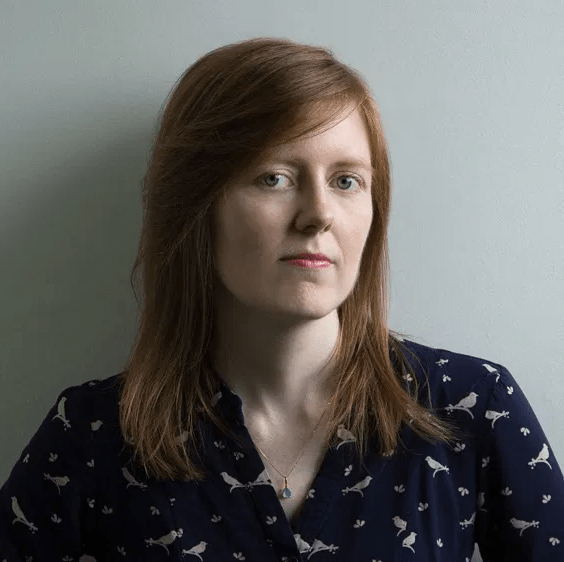
Daria Polatin

There’s only so much pie, you know?


(December 7, 2020) Daria Polatin is a playwright, TV writer-producer and author who is developing a TV limited series based on her novel DEVIL IN OHIO for Netflix. She was a Co-Executive Producer on CASTLE ROCK for Hulu, where her episode “The Laughing Place” was named one of Entertainment Weekly’s Best TV Episodes of 2019. She has been a writer and producer on HUNTERS, JACK RYAN, CONDOR, HEELS and SHUT EYE. Daria received her MFA from Columbia University and is a founding member of THE KILROYS, the advocacy group for gender equality in the American Theatre. She has one son who is 11 weeks old and she describes writer-motherhood in 3 words as: stunning, shifting, softening.

FROM THE EPISODE: READING & VIEWING LIST & REFERENCES

Daria Polatin’s Website
Daria’s Book: Devil in Ohio
Daria’s Play: Palmyra

Daria’s Series:
Castle Rock
Hunters
Jack Ryan
Condor
Heels
Shut Eye

The Kilroys, Daria’s advocacy group for gender equality in the American theater

Chekhov


SOUND BITES

Time is really punctuated when you have a baby. I used to have a certain sensibility of my time and what I could get done, and now the periods I have are much shorter. Having to code switch really is tricky. A few minutes of feeding can feel like hours, and the nap feels like one second. Time just has all these new nuances, even though it is a constant.

Writing outlines is tough. I know a lot of writers outline their projects in different mediums, and it’s just not the most fun to do an outline, but it’s the scaffolding for the cathedral that you’re going to make.

Because of the amount I need to get done, I need to work quickly, and it’s a good lesson in not second-guessing myself. I need to make decisions and move on, whereas, in the past, I may have read a piece over and over and over and improved it one more time. I don’t have time to do that now. It’s about trusting the process and my intuition, trusting that I’ve been doing this for many years. I don’t want to say that I’m shortchanging the process, but I can move through the process much more quickly now. And I have to; otherwise, I couldn’t keep up, or I would have to take on less, either as a writer or as a mother, and I don’t want to do that. I want it all.

There’s never going to be enough time for all of the things, and I just have to make peace with that. I’m always probably going to feel like I’m not doing enough in a certain area, whether it’s this project or that project or with my son or with my husband. There are a lot of things that I’m going to have to be comfortable with. There’s only so much pie, you know?

“There’s never going to be enough time for all of the things, and I just have to make peace with that. There’s only so much pie, you know?” — @DariaPolatin

Every minute of TV costs a lot of money, effort, and energy to make, so you have to be relentless in refining every moment on screen.

I really love when each episode of a show has an arc to it. The Crown does that really well. Each episode contains a theme, a question, and an answer.

Books are the most direct connection between author and reader. There’s the least interference in that form of written material, a direct relationship with the consumer of the story.

“I now understand this very primal, Mama Bear, almost monster feeling of doing anything for your child. I have a new understanding, a visceral understanding, of what that is.” — @DariaPolatin

I want to be a safe space for my son, and I want to be a grounded place that he can always come to for comfort in whatever form that would be.

I’m fearful of not having enough time for everything; most importantly, my son, because he’s the most vulnerable of all of those elements.

I’m trying to stay grounded and teach through example. Taking care of the things I need to take care of is an important thing to do. If I just sacrificed my career and became a mother full-time, that’s not serving me, and I wouldn’t be happy, and that wouldn’t be serving him.

You have to be very present to be able to assess the circumstances and get out of your own expectations of what your child might need. It’s almost meditative, Zen-like, to step back and just look at situations with a clear, fresh perspective without projecting expectations onto your child.

Blair Hurley

There’s something dangerous about a girl who wants something for herself.


(October 22, 2020) Blair Hurley received her A.B. from Princeton University and her M.F.A. from NYU. Her stories are published or forthcoming in Ninth Letter, The Georgia Review, West Branch, Mid-American Review, Washington Square, Hayden’s Ferry Review, Descant, Fugue, and elsewhere. She has received a 2018 Pushcart Prize and scholarships from Bread Loaf and the Kimmel Harding Nelson Center for the Arts. Her debut novel, The Devoted, was published in August 2018 from WW Norton & Company.

FROM THE EPISODE: READING LIST & REFERENCES

Blair Hurley’s website

Blair’s book
The Devoted (WW Norton, 2018)

Rabbit, Run, John Updike (Random House, 1960)

Snuffleupagus’s identity shift on Sesame Street

John Steinbeck

Alice Munro

A Tale for the Time Being, Ruth Ozeki (Penguin Books, 2013)


SOUND BITES

Motherhood is such a powerful identity in our culture, our literature, and our lives that it’s nerve-racking to approach it yourself and to consciously make the decision to adopt this identity.

When I thought about motherhood as a young woman, I thought I should focus on my career and not really think too hard about parenthood. I somehow got the impression that it wasn’t feminist to long to be a mother.

“One problem I have with the ‘having it all’ myth is the idea that you have to somehow add motherhood and career ONTO your life, when there should be a way for these roles to complement each other; to be PART of your life.” — @bhurley

It’s been so great to connect with other writer-moms and see what they went through and what they struggled with at different stages. Connecting with other mothers helps with the sense of being alone.

Before I had my baby, I thought, “It’ll be hard until she reaches X milestone, and then I’ll get my life back and I’ll be myself again.” It’s not really that way at all. It’s taken some adjusting to realize that my identity has changed forever. I’m living a different life now, and that’s perfectly okay. Life is change, and change is not always bad. In this case, it’s been an incredibly positive change. There are so many ways that I feel more access to joyful experiences.

Before I had my daughter, I thought I could write the same way I was writing before, but now I realize that my identity has changed. I’m going to be writing different things, I’m going to be concerned about different things, I’m going to be feeling different ways. And again, that’s not a bad thing. In fact, it will probably enrich my writing in ways that I have yet to see.

I’ve tried to make a distinction between what we generally call sentimentality and what might just be sentiment. It’s a useful distinction to make, because yes, there is a problem with excessive sentimentality in writing that instructs readers reader to feel tragic in a manipulative way, whereas sentiment is just strong feeling. I want my readers to experience strong feelings. I don’t want to be afraid or ashamed of sentiment.

I think women writers, and maybe mother writers in particular, can be denigrated or looked down upon if they’re willing to show emotion. There is a perception that if you write emotion from the perspective of motherhood, it’s inherently sentimental. But realistic writing is about showing emotion, being willing to make a reader feel something.

Many male writers write about domestic spaces and it’s seen as the height of intellectualism and experimentalism. I think about all the many Updike stories, for example, and somehow because it’s from a male perspective, focusing on the male vantage point, it’s seen as more serious, more legitimate than when women writers write about domesticity.

“Many male writers write about domestic spaces and it’s seen as the height of intellectualism and experimentalism, more legitimate than when women writers write about domesticity.” — @bhurley

Moral judgment would be passed on a character who is a mother who does something transgressive like leave a child, even temporarily, to just to get away, and who is not thinking about her child at all times. The stakes are so high for a female character who has a child.

I hope that my daughter will be proud of the work I do. I want her to see me working and to see writing as a major part of my life, something that’s part of my identity.

“I love a woman writer who’s willing to engage with a little bit of cruelty, a thin edge between tenderness and viciousness.” — @bhurley

Motherhood is changing my writing about girlhood; particularly, I’m seeing how fiercely girls want to become—to grow and to become themselves. Even at my daughter’s young age, I can see it in her desires and in the way she’s trying to figure things out and how she gets excited when she’s masters a new skill. It’s a powerful desire to become, which I find deeply moving to witness, and I feel honored to witness.

When I’m writing characters, I want to try to capture that desire and that process of becoming. Everyone wants to become—and when girls are wanting to become, it’s seen as a dangerous thing. There’s something dangerous about a girl who wants something for herself, who wants to transform. I hope to write characters that have that ferocity of desire, and to engage with its danger and risk.

“There’s something dangerous about a girl who wants something for herself.” — @bhurley

Before I became a mother, I thought I would feel resentment, like I was a prisoner unable to work and I would feel horrible about it. But actually, it’s more insidious than that, because I’m too busy feeling joyful with my baby. That’s why the work is not getting done. I’m the jailer. I’m the one keeping myself from writing. I did not expect that at all. The happy aspects of parenting are actually the ones preventing me from being productive right now.

My husband and I have devised a system where we each have one day a week that we’re the primary parent to give the other partner the chance to work.

It takes a concerted effort to find that quiet place I think is essential for good writing. If you’re only trying to write in little bits while feeding the baby, I don’t think you’ll be able to arrive at bolder and deeper and darker ideas.

“It’s important to have unfettered time, however you manage it, and to do your best to honor that time and only focus on writing.” — @bhurley

It’s tempting to feel that any time you take for yourself, you’re taking it away from your child. That can be heartbreaking. I think a lot of women feel that, and it’s so unfortunate because it’s an illusion. It’s so important for women to feel okay about valuing their work and valuing themselves. And ultimately, it’s important for their children to see their mother valuing herself and valuing her work.

We need breathing spaces; we need to have private and quiet spaces for our own growth. I’m trying to remember that it’s good for my child to allow her these spaces. Even in these few months, I’ve seen how it’s usually the moment I take a little step back that she learns a new skill. A silly example: I kept trying to guide her hands and guide her hands to help her hold her sippy cup, and finally, I said, “You figure it out.” And then she did.